Beyond Google: Why Multi-Engine SERP Data Matters (Yandex, Baidu, Bing)
Google-only SERP data is a blind spot for international SEO. How to query Russian and Chinese engines through one web search API, and what cross-engine data shows you.
On this page
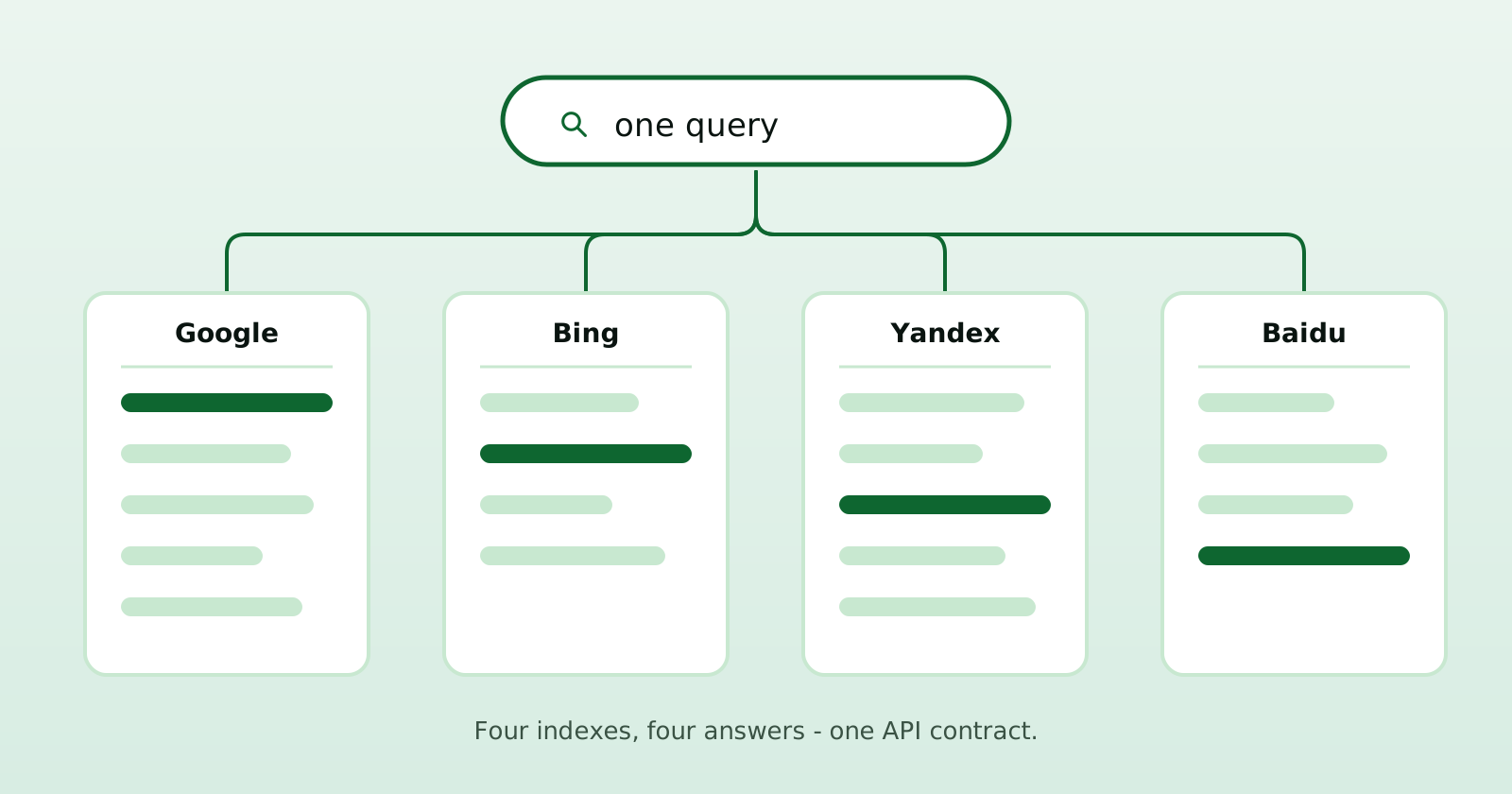
Most SERP tooling assumes the web is Google and everything else is a rounding error. For a lot of use cases that assumption is fine. For international SEO, competitive research, and AI grounding on non-English content, it’s a blind spot that quietly costs you accuracy. This article makes the case for multi-engine SERP data and shows how to query Google, Bing, Yandex, and Baidu through one web search API.
Google is not the whole web
Global search numbers hide large regional differences:
- In Russia and much of the Russian-speaking world, Yandex holds a major share of search and surfaces Cyrillic content, local sites, and regional signals differently from Google.
- In mainland China, Baidu remains an important engine with its own index and ranking model.
- Bing isn’t just a Google clone: it has its own audience, feeds several downstream products, and ranks pages in a noticeably different order.
Market share moves, so current audience analytics should decide what you track. The durable point is simpler: if you only look at Google, you’re optimizing for one view of the world and assuming it generalizes. It often doesn’t.
Cross-engine rank differences are real signal
The same query returns different top-10 results on different engines. That divergence isn’t noise - it’s information.
- For SEO, a page that ranks #3 on Google but #15 on Bing tells you that visibility is engine-specific. It does not diagnose the cause, but it gives you a better place to start.
- For competitive research, competitors who are invisible on Google may dominate Yandex or Baidu in their home market. Cross-engine data surfaces rivals a single-engine view never shows you.
- For AI grounding, several engines widen source discovery. Confidence should come from independent publishers and primary sources, not from the same page appearing in three indexes.
The practical problem has always been cost and complexity: every engine has its own HTML, blocking behavior, and quirks. Four engines mean four parsers to keep working. The fix is a single API that normalizes all of them into one schema.
One API, every engine
With OpenSERP you hit the same endpoint shape per engine and get back the same structured envelope. Self-hosted, no key required:
docker run -p 7000:7000 karust/openserp serve
curl "http://localhost:7000/yandex/search?text=поисковый+api®ion=RU&lang=RU"
curl "http://localhost:7000/baidu/search?text=搜索+api®ion=CN&lang=ZH"
curl "http://localhost:7000/bing/search?text=search+api®ion=US&lang=EN"
Or through the SDK, switching engines is a single field:
import { OpenSERP } from "@openserp/sdk";

const client = new OpenSERP({ apiKey: process.env.OPENSERP_API_KEY });

for (const engine of ["google", "bing", "yandex", "baidu"] as const) {
  const { results } = await client.search({ engine, text: "search api", limit: 10 });
  console.log(engine, "->", results[0]?.title);
}
Store the key as an environment variable:
export OPENSERP_API_KEY="osk_live_xxxxxxxxxxxxxxxxxxxxxxxxxxxxxxxx"
Search several engines in one call
For broad discovery, megaSearch queries multiple engines and merges and deduplicates the results:
const merged = await client.megaSearch({
  text: "open source serp api",
  engines: ["google", "bing", "yandex"],
  mode: "balanced",
  limit: 20,
});

console.log(merged.results.length, "merged, deduplicated results");
That merged list is not a rank comparison. For an actual rank-difference report, run each engine separately and record where your target domain lands:
import os
from openserp import OpenSERP

target = "openserp.org"
keyword = "open source serp api"

def rank_of(results, target):
    for r in results:
        domain = (r.domain or "").lower().removeprefix("www.")
        if domain == target or domain.endswith(f".{target}"):
            return r.rank
    return None

with OpenSERP(api_key=os.environ["OPENSERP_API_KEY"]) as client:
    for engine in ["google", "bing", "yandex"]:
        response = client.search(
            engine=engine, text=keyword, region="US", lang="EN", limit=20
        )
        print(f"{engine}: {rank_of(response.results, target) or 'not in top 20'}")
Run that on a schedule and you have a cross-engine rank tracker - the kind of view single-engine tools structurally can’t give you. When I did exactly that for ten days, many domain-keyword pairs ranked on one engine and were missing from another.
International SEO without four toolchains
If you’re doing SEO for a market outside the Anglosphere, region and language matter as much as engine. Pass them explicitly so you measure the SERP your users actually see:
const ruResults = await client.search({
  engine: "yandex",
  text: "купить кофе онлайн",
  region: "RU",
  lang: "RU",
  limit: 10,
});
The same query on google with region: "RU" and on yandex with region: "RU" can return different pages. For a Russian-market site, the Yandex view is one you cannot ignore. Querying Yandex and Baidu through the same interface you already use for Google makes international SEO tooling practical instead of a maintenance nightmare.
Why this is hard to get elsewhere
Coverage varies widely. Some search APIs focus on Google, some expose many engines, and some return only one merged web-search result. Check the exact engines, locale controls, result depth, and fields you need before choosing a provider.
OpenSERP covers Google, Bing, Yandex, Baidu, DuckDuckGo, and Ecosia behind one contract, self-hosted or managed.
Takeaways
- Google-only data is a blind spot for international SEO, competitive research, and grounding.
- Cross-engine rank differences are signal - track them rather than averaging them away.
- One normalized API removes the maintenance tax of running multiple scrapers.
- Yandex and Baidu support gives you explicit coverage for Russian and Chinese search workflows.
Read the endpoints reference for every engine and parameter, the usage examples for more multi-engine recipes, or run the open-source server and query all six engines yourself.

Written by Rustem
I build OpenSERP - the open-source SERP API behind these posts. Spotted something wrong, or want a topic covered? Get in touch.