Your Keyword Ranks #1 on Bing and #19 on Google. Here's How to Track Both.
I tracked the same keywords on Google, Bing and Yandex for ten days. Most of them ranked on one engine and vanished on another. Here is what that looks like, and how to watch all six engines at once.
On this page
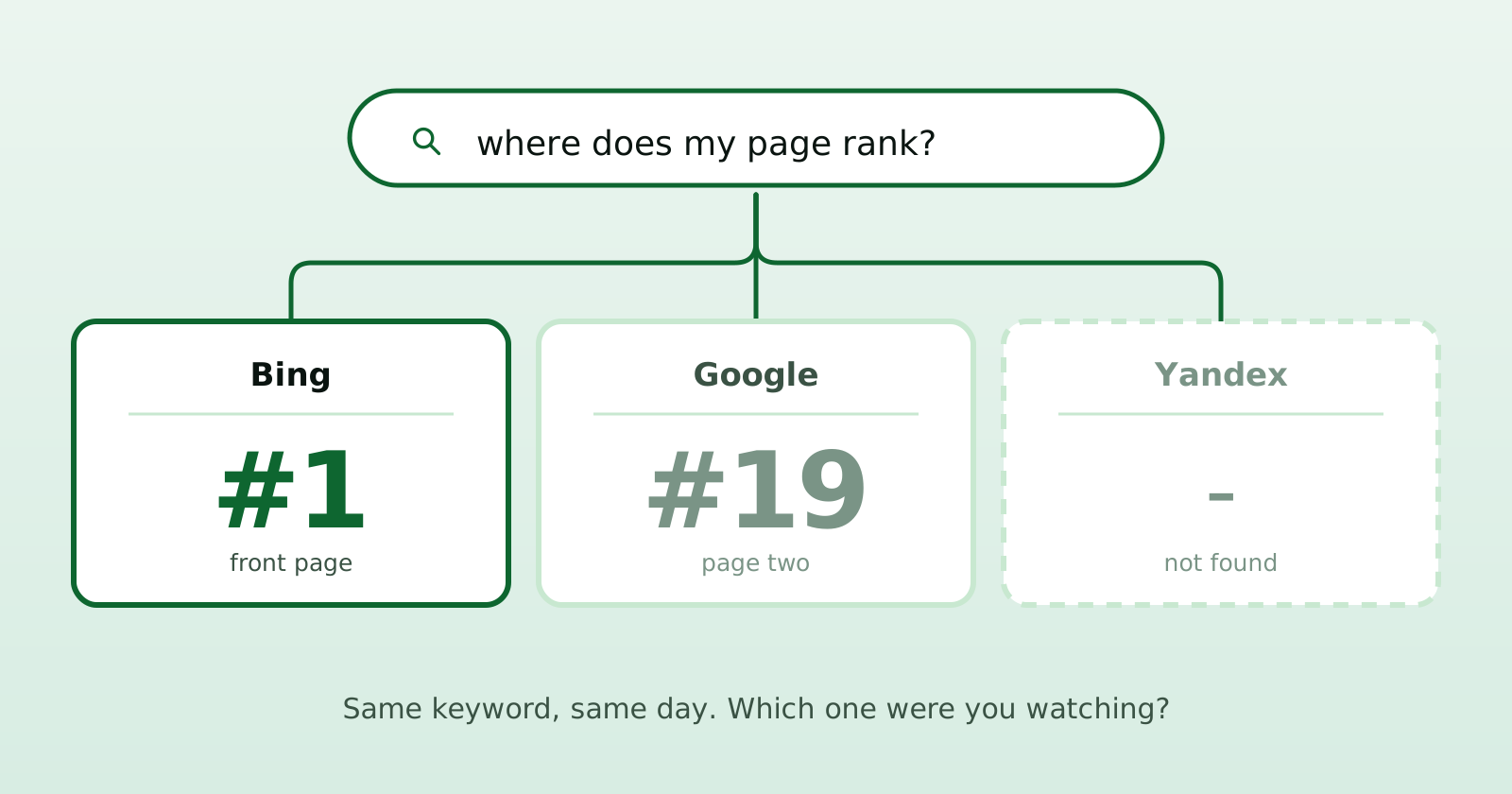
One of my pages sits at the top of Bing for a keyword I care about. Same page, same keyword, on Google? Two pages deep. On Yandex it is back at number one.
I did not change anything between those three checks. I just asked a different engine.
Now think about what that means if you only watch one of them. Watching Google, I write the page off and go hunting for the wrong problem. Watching Bing, I call it a win and move on. Same page, same day, opposite conclusions.
So I stopped guessing. Ten keywords from my own niche, checked every day for ten days with the same monitor settings. Here is what came back.
Most keywords do not agree across engines
I expected positions to differ by a few places. That is not what happened. Most of the keyword and domain pairs I tracked ranked on some engines and were missing entirely from others. Presence, not position, is where engines disagree.
This is not just my site being weird. The competitors do it too. Measured 26 July 2026:
| Domain | Keyword | Bing | Yandex | |
|---|---|---|---|---|
| openserp.org | free serp api |
#20 | #1 | #1 |
| openserp.org | serp api |
- | #2 | - |
| openserp.org | free search api |
- | #9 | #7 |
| brightdata.com | serp api |
#10 | - | - |
| serpapi.com | free search api |
#10 | #7 | - |
| serpapi.com | search engine api |
#4 | #1 | #4 |
| firecrawl.dev | web search api |
#4 | #7 | #9 |
A - means “not in the top 10”. Those are not errors. The engine simply did not return that domain for that query.
Look at the first row. 1st, 1st, 20th. One page, one keyword, one day. And by the time you read this those numbers will have moved, which is the other half of the point.
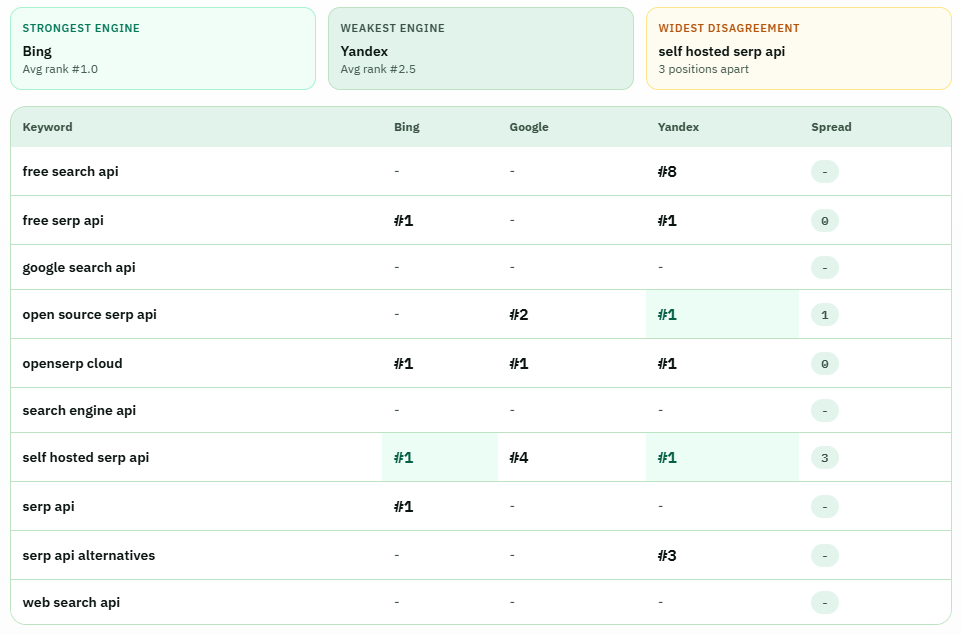
Two things jump out. Presence matters more than position. Going from #3 to #8 is a tuning problem. Going from #1 to not-on-the-page is a strategy problem, and it is the one nobody notices.
Position gaps are real but smaller
When a domain does show up on more than one engine, the spread is usually small. The widest I saw was about five places. On brand terms it collapses to nothing - search a vendor’s own name and all three hand it the top spot.
That is what most people picture when they hear “engines rank differently”, and it turned out to be the boring half. Only a minority of pairs appeared on all three engines. The disagreement piled up in mid-tail queries - the exact ones you have room to compete for.
Why this happens
None of this is mysterious once you stop treating “search” as one thing:
- Different indexes. An engine can only rank what it crawled and kept. Small or new sites land in some indexes long before others.
- Different ranking models. Bing weighs signals differently from Google. Yandex has its own model, tuned around a different web. Baidu even more so.
- Different numbers of organic slots. Google often shows fewer than ten organic results on page one, with the rest of the page going to other blocks. Fewer slots, fewer chances to be in one.
- Different query interpretation. Engines expand, correct and localize queries their own way. “The same query” is not always the same query by the time it hits the index.
- Engines are not independent of each other. Several of the smaller ones lean on a larger index rather than crawling the whole web themselves. One ranking change can quietly move you on more than one engine at a time, and you will not see it if you only watch Google.
Here is the part that matters. A single-engine number is not your visibility. It is one engine’s opinion, and you have no idea how representative it is until you check a second one.
I used three engines because those are the ones I care about. Your market might be Baidu, or DuckDuckGo, or Ecosia. All six work the same way, and the interesting question never changes: which ones disagree?
Why this costs you money
The expensive part is misdiagnosis. A page missing from Google looks like a content problem, so you rewrite it. But if that same page is #1 on Bing, rewriting it blindly is harder to justify. The issue may be indexing, authority, query fit, locale, or something Google-specific. Different diagnosis, different fix, and Google-only tracking cannot tell them apart. You end up rewriting pages before you know what is broken.
At the time of this test, Google handled roughly 90% of global search, which is exactly why people stop there. The remaining 10% is not spread evenly: Bing ships inside Windows, developer and B2B niches can skew away from Google, and Yandex or Baidu can be material if you sell into Russia or China.
There is a newer reason too: some chat assistants ground their answers in live search, and they do not all use Google. The engine behind an assistant can affect whether your page gets cited or left out.
None of this means tracking six engines forever. It means knowing whether the one number you stare at is representative. You only learn that by checking a second.
Doing this yourself
You do not need a product for this. A self-hosted rank tracker in about 40 lines of Python, built on a SERP API, SQLite and cron, is enough for a handful of keywords and one domain.
Then you hit the things I got tired of hand-rolling:
- history that survives a laptop reformat
- a diff between today and last Tuesday without writing SQL
- a nudge when something changes, instead of remembering to look
- competitor rows next to mine without a second script
The version I ended up building: Search Monitor
So I built Search Monitor, now live in OpenSERP Cloud. Give it keywords, pick your engines and regions, name a domain to track, and it runs on a schedule. Each run takes one SERP snapshot per keyword and engine, then keeps the rows. One capture is one keyword checked on one engine. Every number in this post came out of it.
All six engines are there - Google, Bing, Yandex, Baidu, DuckDuckGo, Ecosia - in any combination. Watch one. Watch all six.
Setup is five steps: keywords, coverage, domains, schedule, review. The review step quotes you before you commit, per run and per month. Set one up here.
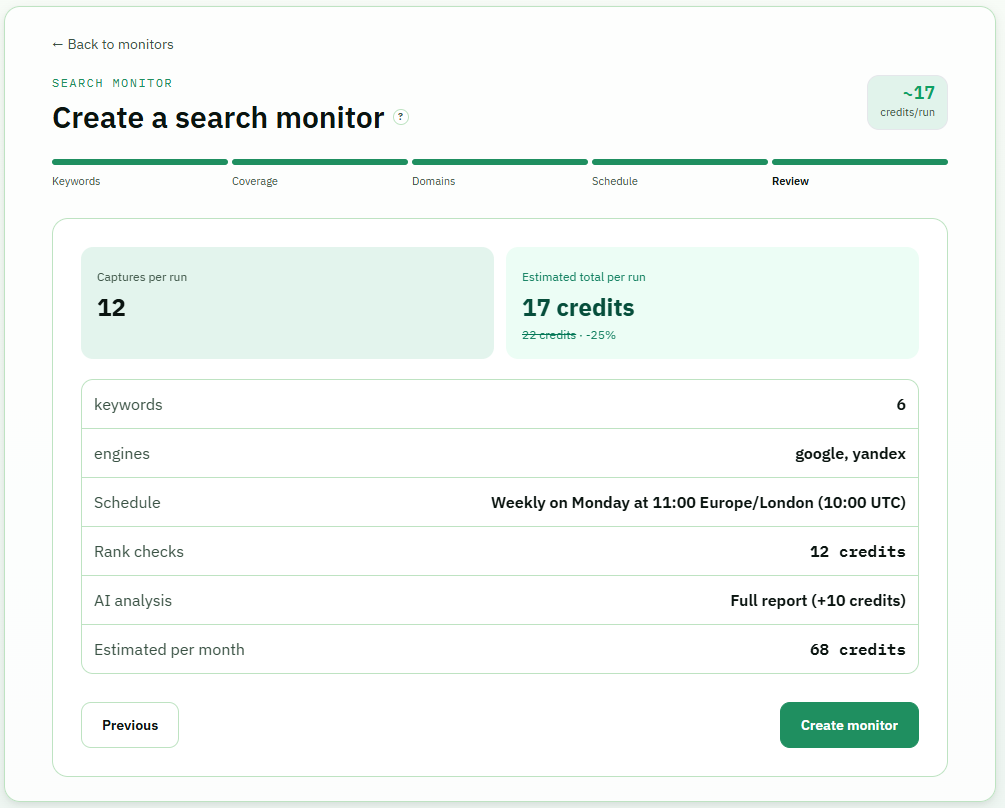
See the struck-through price? That is the launch offer: every Search Monitor run is 25% off for the next two weeks. It comes off automatically, no code to enter. If you have been meaning to find out where you actually rank, this is the cheap fortnight to do it.
What it does that a cron script does not
Cross-engine view. One row per keyword, one column per engine, plus a spread column. The disagreements are the whole point of the screen. You are hunting for rows where one engine has you and another does not.
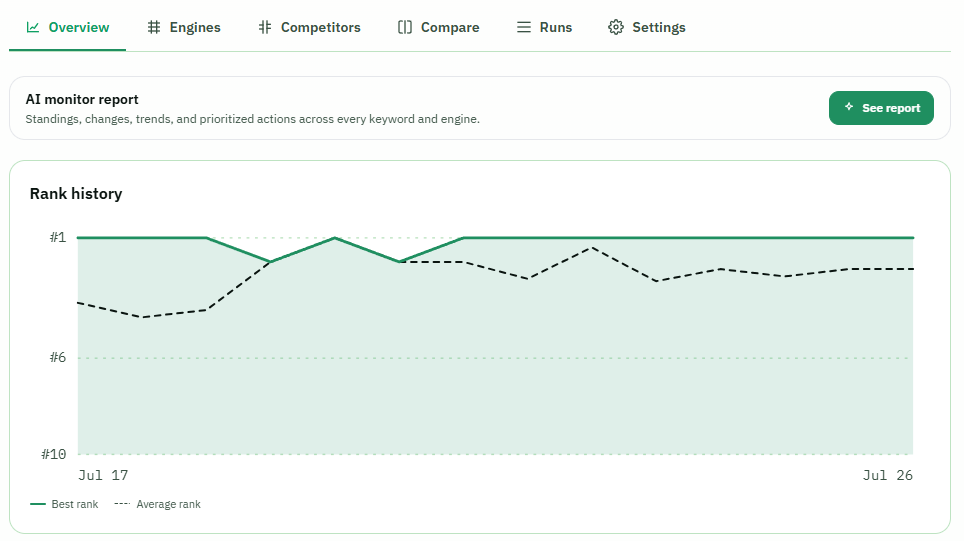
Rank history. Best and average rank over time per keyword, so you can see whether last week’s dip was a blip or a trend.
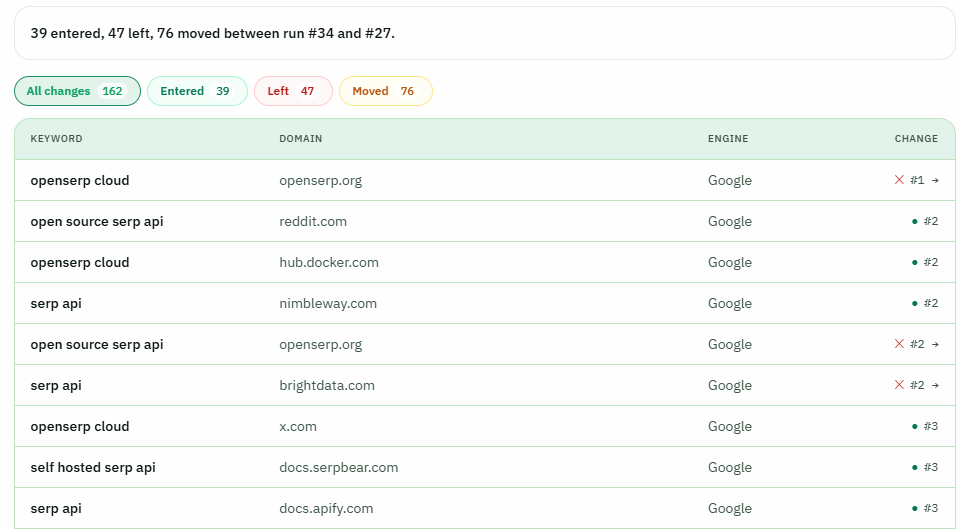
Run comparison. Pick two runs, get what entered, what left, what moved. Comparing 26 July against 20 July: 39 result rows entered the tracked depth, 47 left, and 76 changed position. That is 162 result-row changes across 30 tracked SERPs in six days. Consecutive daily runs rarely matched either. You cannot see churn like that by checking manually, because by the time you look again you have forgotten what it said before.
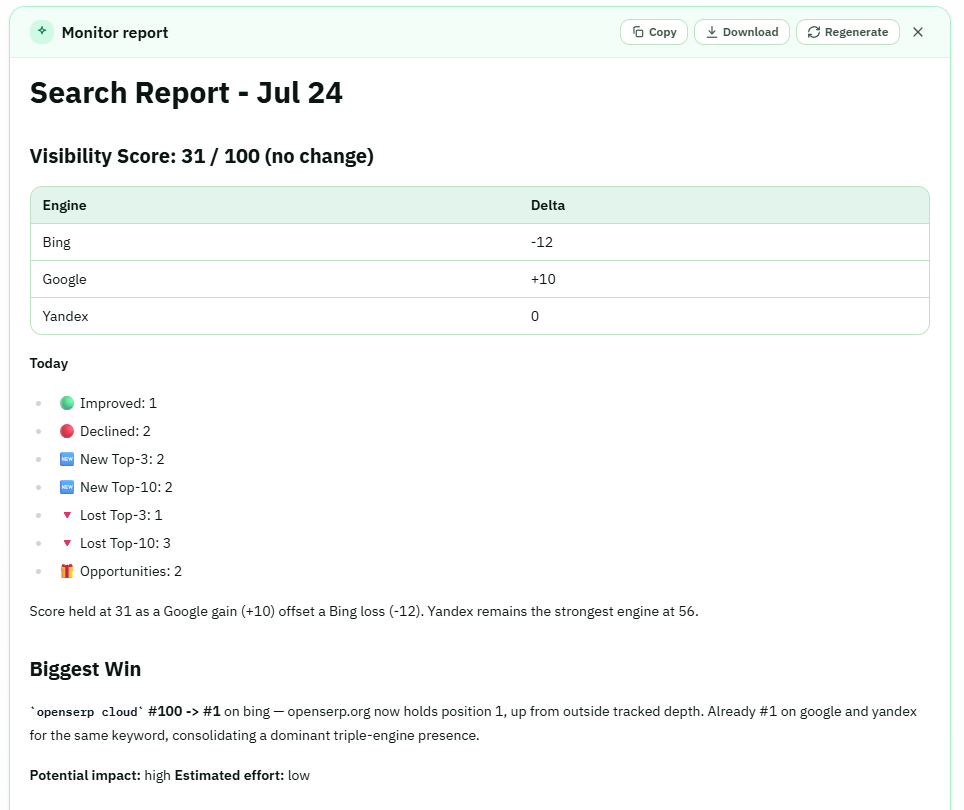
Change digests. After each scheduled run you get a visibility score, per-engine deltas, and what actually moved. One report showed Google at +10 and Bing at -12. Google alone looked great; Bing alone looked bad. Together, the score was nearly flat.
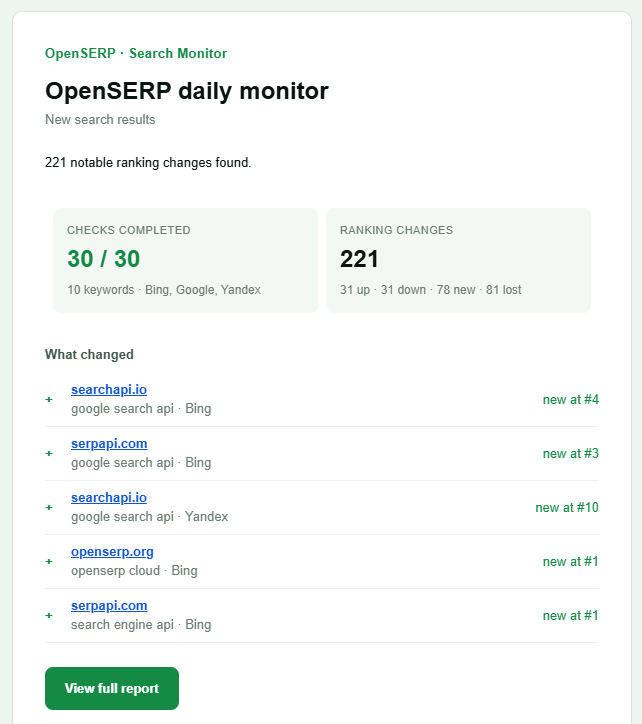
Alerts and email. Position drops, disappearances, and competitor overtakes can notify you by email or webhook, so the normal state is not checking a dashboard.
The full results, not just the number. Every run keeps its rows, so you can audit a position and see who took the slot above you. A tracker that stores #7 and throws the page away cannot answer that later.
When you should not bother
Sell into one market, traffic 95% Google? Multi-engine tracking is a nice-to-have. Go spend the effort somewhere else. It starts to matter when:
- you sell internationally, or into markets where Google is not king - Yandex in Russia, Baidu in China, DuckDuckGo and Ecosia among privacy-minded users in Europe and the US
- you are in a technical or developer niche, where the non-Google engines skew differently
- you need to know whether a visibility problem is engine-specific before investigating indexing, ranking, or query fit
- you want early warning on competitors that may break through on one engine before they break through on the others
Try it
DIY route: the 40-line Python tracker does the job, and OpenSERP is open source. You own the data, you maintain the cron.
Want to skip that part? Search Monitor runs all six engines for you, with history, diffs and alerts. You pay per capture and see the quote before committing, and pointing it at a competitor’s domain is as easy as your own. Every run is 25% off for the next two weeks.
Either way, go check a second engine. The first one is not telling you the whole story.

Written by Rustem
I build OpenSERP - the open-source SERP API behind these posts. Spotted something wrong, or want a topic covered? Get in touch.