 vs

OpenSERP: a free, open-source alternative to SerpAPI
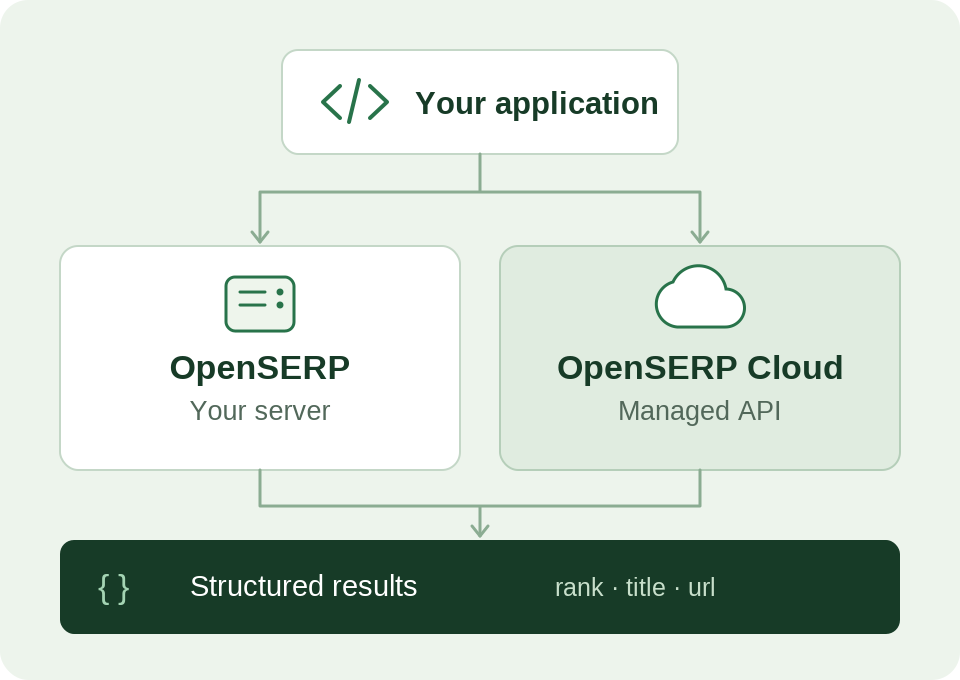
Get structured search results without a per-query software fee. Self-host OpenSERP under the MIT license, or use OpenSERP Cloud when you prefer a managed API.
The short answer
Stay with SerpAPI when
- You rely on Maps, Shopping, Scholar or other specialized APIs
- A plan with a monthly allowance suits you
Switch to OpenSERP when
- You need web results from six engines, not only Google
- You want to self-host with no per-query software fee
- You prefer PAYG credits to a monthly plan
Side by side
OpenSERP / Cloud
Self-hosted with no software fee; Cloud uses credits
- What you get
- Six engines, web and image results, multi-engine search and URL extraction
- Best for
- Teams that want a search API with a self-hosted option
SerpAPI
Managed search API with search allowances
- What you get
- Search results and specialized APIs such as Maps, Shopping and Scholar
- Best for
- Teams that need specific search verticals

Serper
Managed Google search API, prepaid credits
- What you get
- Google search and related result types
- Best for
- Google-focused apps and automation

DataForSEO
Managed data platform with task-based billing
- What you get
- Live and queued SERP tasks alongside other SEO datasets
- Best for
- SEO pipelines that need task workflows

SearXNG
Open-source, self-hosted metasearch
- What you get
- Search page and configurable JSON output across many sources
- Best for
- Teams building a private search experience
How to decide
What free self-hosting includes
No license fee and no per-query software charge. You still pay for hosting and run the server, updates and capacity. Compare that total with a managed service before moving production traffic.
Check coverage before you switch
OpenSERP supports Google, Bing, Yandex, Baidu, DuckDuckGo and Ecosia. If you depend on Maps, Shopping or another vertical, check that endpoint directly - the same engine name does not mean the same data.
Plan a response mapping
Keep samples of your current requests and responses. Map query, region and language settings, adapt the fields your code reads, and test empty responses, errors and deeper pages.
Use Cloud for managed access
Cloud gives you Bearer API keys, a dashboard, usage history and Search Monitor. New accounts get 60 starter credits with no card; after that, top up as needed.
Frequently asked questions
Is there a free alternative to SerpAPI?
Yes. OpenSERP is an MIT-licensed SERP API you can self-host, with no license or per-query software fee. Hosting and running the server are on you. Cloud is a paid managed option with 60 one-time starter credits.
What are the main alternatives to SerpAPI?
OpenSERP and SearXNG can be self-hosted. Serper and DataForSEO are managed alternatives with different coverage and billing. Choose by the engines, result types and operating model you need.
How does OpenSERP pricing compare to SerpAPI?
Self-hosted OpenSERP has no per-query software fee. OpenSERP Cloud uses pay-as-you-go credits with no subscription or monthly minimum. SerpAPI sells plans with search allowances. Compare current prices for the same result depth, engines and workload.
Can I migrate from SerpAPI without rewriting everything?
Usually you keep the surrounding workflow but change request settings, authentication and response parsing. Test a small set of real queries before moving production traffic.
Do I have to self-host to avoid SerpAPI?
No. OpenSERP Cloud gives you managed access and a dashboard. The response format matches the open-source engine; only the base URL and Bearer API key differ.
Sources
Written by the team building OpenSERP. Product details were checked against the primary sources below. This is a feature comparison, not a performance benchmark. Product names and logos are trademarks of their owners.